
The MotoGP Championship represents the absolute pinnacle of two-wheeled motorsport, blending cutting-edge aerospace engineering with raw, unadulterated human courage. Unlike production-based racing series, these purpose-built prototype motorcycles are designed solely to conquer the world’s most demanding race tracks. For millions of fans worldwide, the championship delivers unmatched drama where split-second decisions at 220 mph dictate the boundary between triumph and disaster.
KEY TAKEAWAYS
- Prototype Machinery: MotoGP bikes are custom-built, multimillion-dollar prototypes that are not street-legal.
- Weekend Format: Modern race weekends feature a short, high-intensity Sprint race on Saturday and the traditional Grand Prix on Sunday.
- Three-Tier System: The championship paddock consists of Moto3, Moto2, and the premier MotoGP class.
- Strategic Depth: Success relies heavily on tire management, aerodynamic setups, and real-time electronic mapping adjustments.
The Anatomy of a MotoGP Prototype
To understand the MotoGP Championship, one must first understand the machines. Unlike World Superbike (WorldSBK), where racers compete on highly modified versions of production motorcycles you can buy in a showroom, MotoGP bikes are pure prototypes. They are rolling testbeds of proprietary technology developed by elite manufacturers including Ducati, Yamaha, Honda, KTM, and Aprilia.
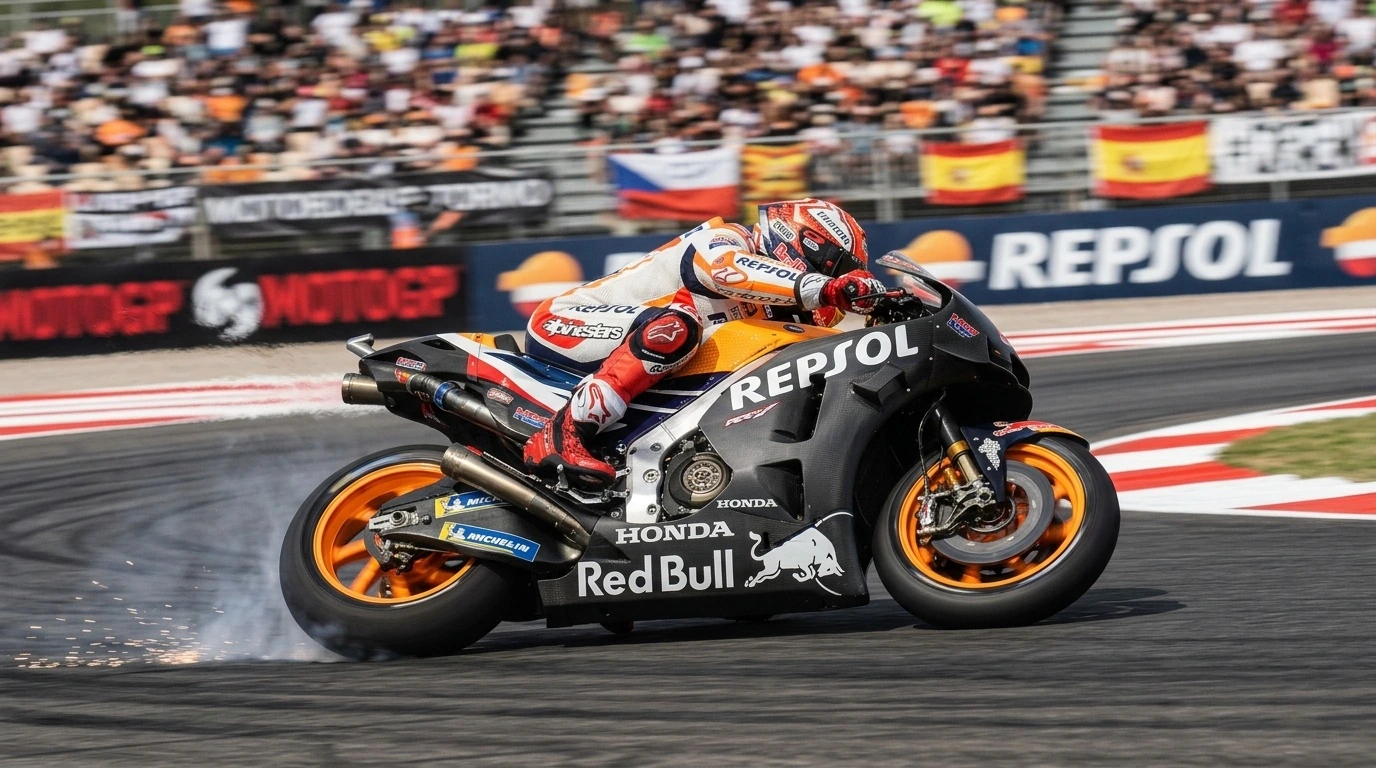
These machines utilize 1000cc four-cylinder engines capable of producing upwards of 250 horsepower while weighing a mere 157 kilograms (346 pounds) dry. This power-to-weight ratio allows them to accelerate from 0 to 60 mph in under 2.5 seconds. To keep these mechanical beasts on the ground, manufacturers heavily invest in aerodynamics, utilizing complex winglet configurations that generate downforce to prevent front-wheel lift (wheelies) under acceleration.
Additionally, modern MotoGP bikes feature sophisticated ride-height devices. These hydraulic systems allow riders to mechanically lower the rear (and sometimes front) of the bike coming out of corners. Lowering the center of gravity drastically reduces wheelies, allowing for maximum acceleration down long straightaways.
The Three Tiers of Grand Prix Racing
The road to the premier class is structured through a strict feeder system. Each tier features distinct technical regulations designed to highlight rider talent while managing operational costs.
| Class | Engine Specs | Approx. Power | Minimum Weight |
|---|---|---|---|
| Moto3 | 250cc Single-Cylinder | 60 hp | 152 kg (Bike + Rider) |
| Moto2 | 765cc Three-Cylinder (Triumph spec) | 140 hp | 217 kg (Bike + Rider) |
| MotoGP | 1000cc V4 or Inline-4 | 250+ hp | 157 kg (Bike only) |
While Moto3 rewards draft-heavy, pack-racing tactics due to lower top speeds, Moto2 challenges riders with heavier bikes and no electronic rider aids like traction control. This makes Moto2 the ultimate training ground for managing high-powered machinery before stepping up to the premier MotoGP class.
Understanding the Race Weekend Format
A MotoGP Grand Prix weekend is a meticulously scheduled three-day event. To maximize entertainment and fan engagement, the weekend format balances practice sessions, high-stakes qualifying, and two distinct races.
- Friday Practice: Riders take to the track for Free Practice 1 and a timed Practice session. The combined times from the afternoon Practice session determine which top ten riders secure an automatic entry into Qualifying 2 (Q2).
- Saturday Qualifying & Sprint: Riders who did not make the top ten on Friday must compete in Qualifying 1 (Q1). The fastest two riders from Q1 advance to Q2, where the top 12 battle for pole position. Later on Saturday afternoon, riders compete in the Sprint Race, which is exactly half the distance of Sunday’s main race and offers half the championship points.
- Sunday Grand Prix: The main event. This is the full-distance race where strategy, physical endurance, and tire management are tested to their limits.
Pro Tip: Pay close attention to Saturday's Sprint race. Because riders don't have to preserve their tires for a full race distance, they can ride at maximum attack. The tire choices and overtaking zones utilized during the Sprint offer crucial clues for Sunday's tactical approach.
Strategic Nuances: Tires, Electronics, and Weather
Winning a MotoGP Championship requires far more than twisting the throttle. Teams must navigate complex variables that can change in a matter of minutes.
The Tire Gamble
Michelin, the official tire supplier, provides three slick tire compounds for dry weather: Soft, Medium, and Hard. A softer tire offers immediate grip but degrades quickly, whereas a harder tire takes longer to warm up but maintains consistent performance over a 45-minute race. Choosing the wrong combination can cause a rider to slide down the order in the final laps as their grip evaporates.
Flag-to-Flag Races
When weather conditions turn volatile, MotoGP utilizes "flag-to-flag" rules. If it begins to rain during a dry race, officials wave the white flag, signaling to riders that they can enter the pit lane to swap their current bike for a second machine pre-configured with wet-weather tires, softer suspension, and carbon-fiber brake covers (which help keep brake temperatures up in the cold rain). Timing this swap correctly is a high-stakes gamble that can win or lose a race.
Two Real-World Championship Scenarios
To see these dynamics in action, let us look at how strategy plays out on track:
- Scenario A (The Tire Whisperer): At a highly abrasive track like Phillip Island in Australia, a rider chooses a Hard rear tire while the rest of the front row opts for the Soft. For the first ten laps, the rider drops back to 6th place, seemingly struggling for pace. However, by lap 18, the front-runners' soft tires begin to blister. The patient rider easily carves through the field, utilizing their superior remaining grip to take the victory.
- Scenario B (The Mixed-Weather Master): During a race in Assen, light rain starts falling on lap 5. The leader immediately dives into the pits to swap to a wet bike. However, the rain stops almost instantly, and the track surface remains warm enough to dry quickly. The riders who stayed out on slick tires gain a massive advantage, while the leader is forced to return to the pits to swap back, finishing laps behind the leaders.
Frequently Asked Questions
Q: How many points does a rider get for winning a MotoGP Grand Prix?
A: A Grand Prix victory awards 25 points to the winner. Second place gets 20, third gets 16, and points scale down to 15th place, which receives 1 point. Saturday's Sprint race awards 12 points to the winner, scaling down to 9th place.
Q: What is the purpose of the knee sliders on a rider's suit?
A: Knee (and elbow) sliders are made of hard plastic or wood. Riders touch them to the ground to gauge their lean angle and stabilize the bike through corners, acting as a physical sensor for available traction.
Q: Why do MotoGP riders stick their leg out when braking?
A: Known as the "leg dangle," this technique acts as an aerodynamic brake, creates a localized low-pressure zone to help stabilize the bike under heavy braking, and shifts the rider's center of gravity slightly inward to aid corner entry.
Q: Are traction control and ABS allowed in MotoGP?
A: Highly sophisticated traction control, anti-wheelie, and engine braking systems are managed by a mandatory, unified spec ECU (Engine Control Unit) to keep competition fair. However, Anti-lock Braking Systems (ABS) are strictly banned; riders must control brake pressure entirely by hand.
The Final Lap
The MotoGP Championship remains one of the most thrilling spectacles in modern sports because it refuses to compromise on speed or danger. As manufacturers push the boundaries of materials science, aerodynamics, and synthetic fuels, the human element remains the ultimate deciding factor. To truly appreciate MotoGP, watch not just the overtaking maneuvers, but the subtle chess match played through tire choices, riding lines, and electronic settings over the course of a race weekend. That is where championships are truly won.