
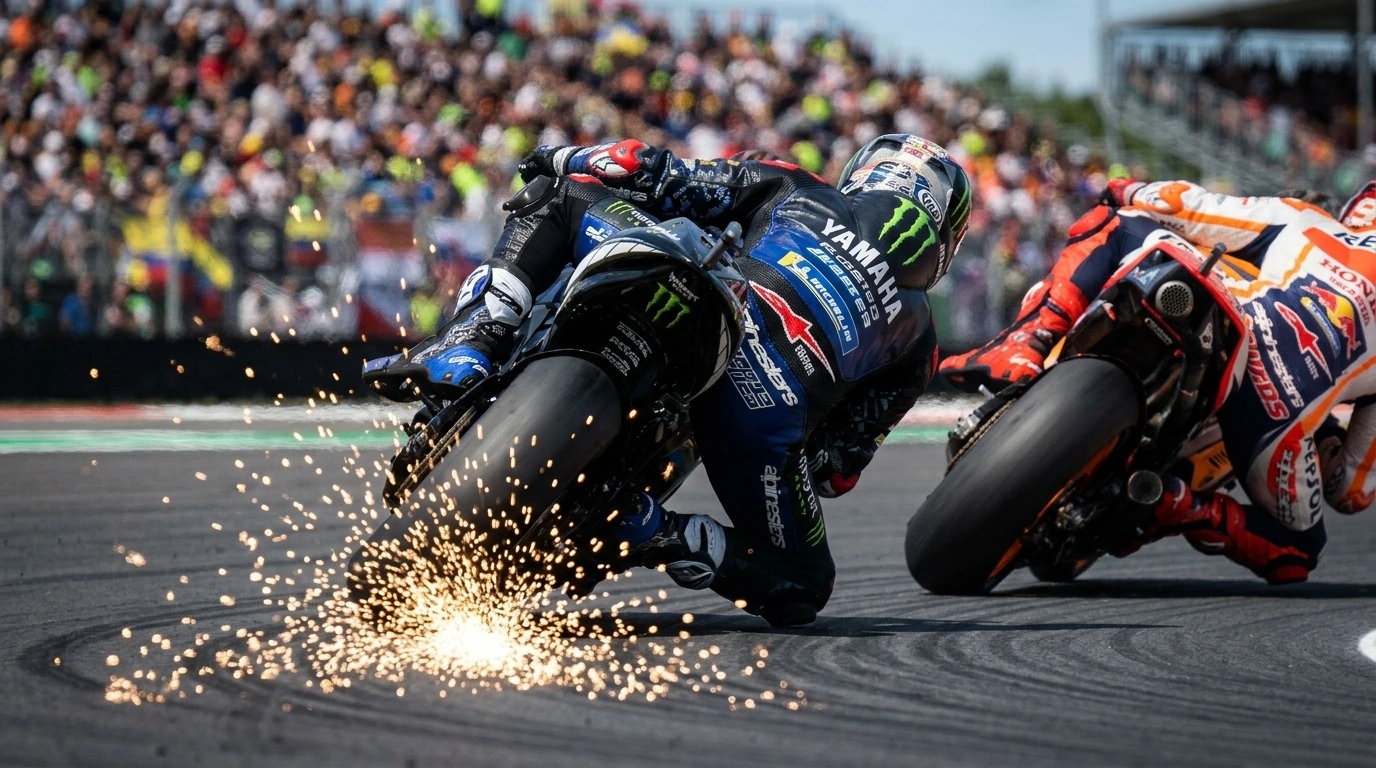
The MotoGP season stands as the absolute pinnacle of two-wheeled motorsport, blending cutting-edge prototype engineering with daredevil athleticism. Spanning across multiple continents over nine months, the championship demands unwavering consistency, strategic brilliance, and physical resilience from riders and teams alike. Whether you are a newcomer trying to make sense of the weekend schedule or a veteran fan optimizing your viewing setup, navigating the season requires a solid understanding of how the sport operates today.
KEY TAKEAWAYS
- Two Races per Weekend: The modern MotoGP weekend features a short Saturday Sprint and the traditional Sunday Grand Prix.
- Crucial Friday Sessions: Friday afternoon practice directly determines which riders bypass Qualifying 1 to secure a spot in the pole-position shootout.
- Circuit Variances: Track layout and climate heavily influence bike setups, favoring different manufacturers depending on the venue.
- Flexible Viewing Choices: Fans must balance the premium global coverage of MotoGP VideoPass against local broadcast packages.
The Anatomy of a MotoGP Season
A typical MotoGP season is a grueling global tour that begins in the spring and runs through late autumn. The calendar is carefully structured to balance geographic clusters, moving from early-season flyaway races in the Middle East and the Americas, through a dense European summer leg, before heading to the Asia-Pacific region and returning to Europe for the season finale.
Managing the logistics of this journey is a monumental task. Teams transport tons of sensitive prototype equipment, spare parts, and hospitality units across oceans. For the riders, the physical toll of constant jet lag, shifting climates, and back-to-back race weekends (often referred to as "double-headers" or "triple-headers") makes off-track recovery and physical conditioning as critical to championship success as raw speed on the tarmac.
Deciphering the Weekend Format: Sprints vs. Grand Prix
The introduction of the Saturday Sprint race has fundamentally changed how teams approach a Grand Prix weekend. Rather than spending Friday and Saturday morning focusing solely on long-run race pace, teams must now prepare for two very different competitive scenarios.
The Saturday Sprint
The Sprint is a half-distance race held on Saturday afternoon. It offers half-points and features aggressive, flat-out racing because tire wear and fuel consumption are rarely limiting factors. Riders can use softer, high-grip tire compounds and push at maximum capacity from the lights to the flag.
The Sunday Grand Prix
The Sunday race is the main event, running the full traditional distance. Here, strategy reigns supreme. Riders cannot simply ride at 100% capacity on every lap; they must manage tire degradation, monitor fuel maps, and adapt to the changing weight of the bike as the fuel load burns down.
Scenario 1: The Tire Strategy Dilemma
During a hot weekend at the Catalunya circuit, a rider might choose the soft rear tire for the Saturday Sprint, knowing it will easily last the short duration while providing maximum cornering grip. However, for Sunday's full-length race, that same soft tire would deteriorate rapidly after twelve laps. The rider must opt for the medium or hard compound, requiring a completely different riding style that prioritizes smooth throttle application to preserve the tire's edge grip for the final laps.
Key Circuit Types and Their Engineering Challenges
No two tracks on the MotoGP calendar are identical, and different layouts play to the strengths of different motorcycle designs. Understanding these track characteristics helps fans predict which teams and riders will excel on any given weekend.
- Stop-and-Go Tracks: Circuits like Spielberg (Austria) or Motegi (Japan) feature hard braking zones followed by sharp, slow corners and long straightaways. These tracks reward bikes with immense braking stability and explosive engine acceleration.
- Flowing, High-Speed Tracks: Circuits like Assen (Netherlands) or Phillip Island (Australia) consist of fast, sweeping corners where riders carry high momentum. These venues favor bikes with exceptional chassis balance, front-end feedback, and smooth corner-entry characteristics.
Scenario 2: Adapting to Track Temperatures
At the Phillip Island circuit, cold winds blowing off the ocean can cause track temperatures to drop rapidly. A manufacturer whose bike struggles to generate tire temperature quickly will find its riders sliding off line in the opening laps. Conversely, a team that can get their tires up to the optimal operating window immediately will gain a massive, early advantage, even if their bike lacks top-end straight-line speed.
Comparing the Two Race Formats
To understand how points and strategies differ across a single race weekend, refer to the comparison table below:
| Feature | Saturday Sprint | Sunday Grand Prix |
|---|---|---|
| Race Distance | Approximately 50% of the Sunday distance | Full Grand Prix distance (typically 110-120 km) |
| Points Awarded | 12 points for 1st down to 1 point for 9th | 25 points for 1st down to 1 point for 15th |
| Tire Management | Minimal; riders push at maximum pace throughout | Critical; managing degradation is key to the finish |
| Fuel Load | Reduced fuel tank capacity (maximum 12 liters) | Full fuel tank capacity (maximum 22 liters) |
Pro Tip: Track Evolution and the "Moto2 Grip" Effect
Pay close attention to how track conditions change on Sunday afternoon. The intermediate Moto2 class uses different tire compounds than MotoGP. When their race ends just before the premier class starts, they leave a layer of different rubber on the racing line. This can temporarily reduce grip levels for the MotoGP riders in the opening laps, catching out front-runners who expect the same track conditions they experienced during morning warm-ups.
Choosing How to Watch: VideoPass vs. Local Broadcasters
Following a full MotoGP season requires choosing a viewing platform that fits your budget and schedule. Fans generally have two main paths:
1. MotoGP VideoPass (The Direct Option)
This is the official, premium streaming service provided by Dorna (the sport's commercial rights holder). It offers live coverage of every single practice, qualifying session, Sprint, and Grand Prix across MotoGP, Moto2, Moto3, and MotoE. It also includes an extensive archive of past seasons, multi-camera feeds, and live telemetry.
- Pros: No commercial interruptions, comprehensive coverage, on-demand replays, and multi-screen options.
- Cons: High annual subscription cost; may be subject to local blackout restrictions in countries with exclusive broadcast deals.
2. Local Cable and Streaming Broadcasters
In many regions, major sports networks hold the exclusive rights to broadcast the races (such as TNT Sports in the UK, Max/truTV in the US, and Foxtel/Kayo in Australia).
- Pros: Often bundled with existing TV or streaming subscriptions, saving fans money if they already watch other sports.
- Cons: Coverage of practice sessions can be limited, and live broadcasts may be interrupted by commercial breaks or pre-empted by other sporting events.
Frequently Asked Questions
How does qualifying work in MotoGP?
Qualifying is split into two sessions: Q1 and Q2. The ten fastest riders from the combined times of the Friday afternoon Practice session secure automatic entry into Q2. The remaining riders compete in Q1, where the top two finishers earn the final two transfer spots into Q2. The 12 riders in Q2 then battle for the top 12 grid positions, while the rest of the grid is filled based on the Q1 results.
What are "Flag-to-Flag" races?
If rain begins to fall during a dry race (or vice versa), the race is not red-flagged or stopped. Instead, officials declare it a "flag-to-flag" race. Riders are permitted to enter the pit lane and swap to their second bike, which is already prepared with wet-weather tires, different brake discs, and a softer suspension setup.
What is the difference between MotoGP, Moto2, and Moto3?
MotoGP is the premier class, featuring custom-built 1000cc prototype motorcycles. Moto2 serves as the intermediate class, utilizing a control 765cc Triumph engine and spec chassis. Moto3 is the lightweight entry class, featuring highly competitive, single-cylinder 250cc machines that reward drafting and close-quarters racing.
How does the points system work for the championship?
In the Sunday Grand Prix, points are awarded to the top 15 finishers, with 25 points for a win, 20 for second, and 16 for third. In the Saturday Sprint, points are awarded only to the top nine finishers, with 12 points for a win, 9 for second, and 7 for third. The rider with the most accumulated points across both formats at the end of the season wins the World Championship.
The Finish Line
To truly appreciate a MotoGP season, look beyond the simple race-day results. Follow the narrative arc of the calendar, notice how track layouts shift the balance of power between manufacturers, and watch how riders adapt their strategies between the sprint and the main race. By understanding the technical nuances and choosing the right viewing platform, you can turn every race weekend into an immersive, high-speed spectacle.