
To the uninitiated, piloting a MotoGP machine might look like a test of engineering over human athleticism. In reality, MotoGP riders are among the most physically and mentally conditioned athletes on Earth, balancing 300-horsepower prototype motorcycles on contact patches no larger than a credit card. Understanding these elite competitors requires looking past the raw speed to examine the extreme physical tolls, tactical intelligence, and career trajectories that define the premier class of motorcycle racing.
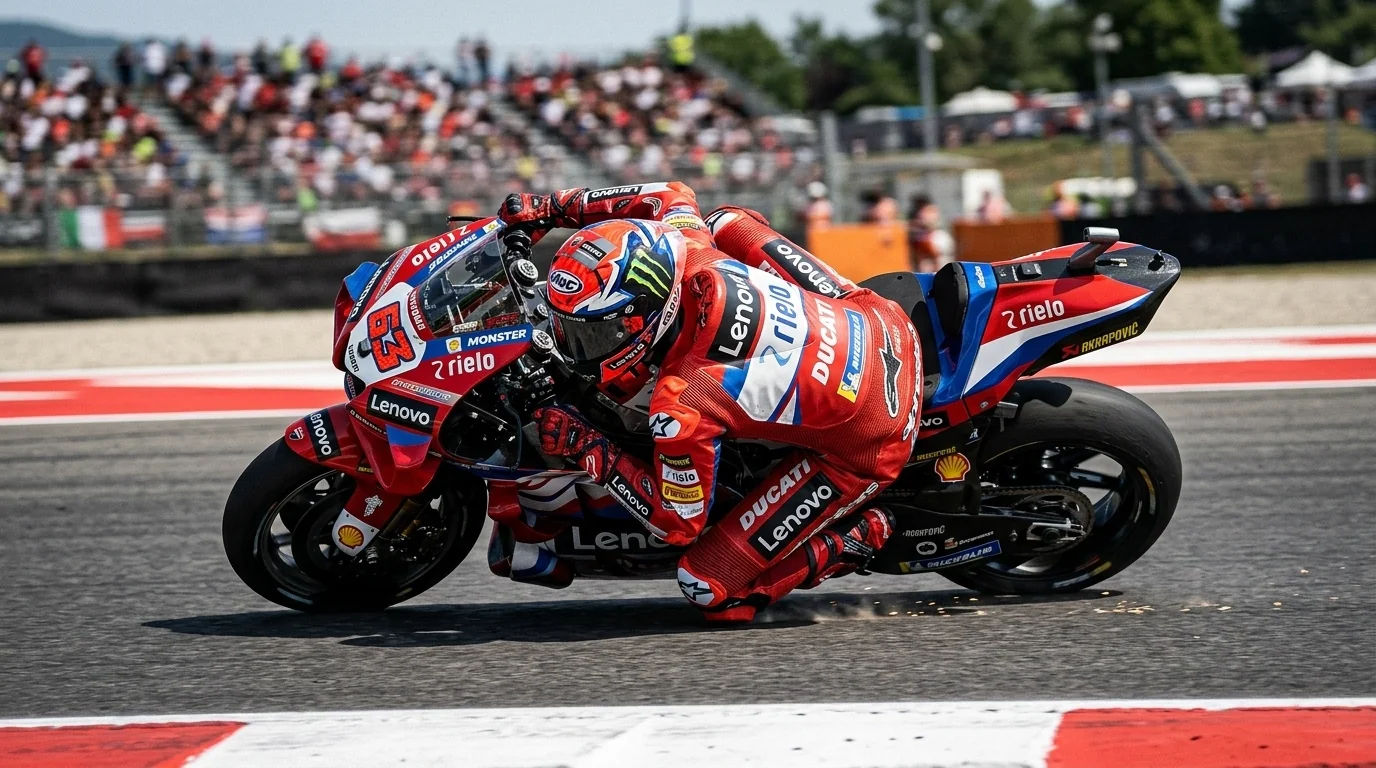
- Riders, Not Drivers: The term "riders" is used because steering a motorcycle requires active, whole-body physical inputs, unlike driving a car.
- Extreme Physicality: Competitors endure heart rates of 170–180 bpm for 45 minutes while resisting intense braking G-forces.
- The 2026 Landscape: The grid features a hyper-competitive mix of multi-time champions and young prodigies adapting to complex aerodynamics.
- Structured Pathway: Junior championships like Moto3 and Moto2 serve as vital filters to prepare riders for the brutal transition to MotoGP.
The Physical and Mental Anatomy of a MotoGP Rider
Though casual observers occasionally refer to them as "MotoGP drivers," the distinction of "rider" is critical. A racing driver uses a steering wheel and pedals while secured in a carbon-fiber cockpit. A MotoGP rider, by contrast, must use their entire body as a aerodynamic and mechanical lever. To turn a prototype bike at 100 mph, a rider hangs off the side of the machine, pressing their knees and elbows against the asphalt to manage the center of gravity.
The physical demands of this style of riding are immense. Under heavy braking at the end of long straights, riders experience deceleration forces up to 1.5g to 2g. Without seatbelts, they must support their entire body weight using only their core, thighs, and upper body strength to keep from being thrown over the handlebars. This constant strain often leads to chronic exertional compartment syndrome, commonly known as "arm pump," a condition where pressure builds up in the forearms, cutting off blood flow and requiring surgical intervention to release the fascia.
Mentally, the sport requires sustained, hyper-focused decision-making. At speeds exceeding 220 mph (350 km/h), a fraction of a second's delay in braking or a millimeter's error in throttle application can result in a catastrophic crash. Riders must monitor tire degradation, track temperature, fuel maps, and the positions of surrounding competitors, all while their heart rate hovers near its maximum threshold.
Pro Tip: Watch a rider’s helmet closely during corner entry. They do not look at the turn itself; they look through the corner toward the exit apex. This visual targeting allows their subconscious mind to calculate the trajectory and adjust body position before the bike even reaches the turn.
The 2026 Grid: Titans and Adaptability
The modern MotoGP grid is arguably the most competitive in the sport's history. The margin separating the pole-sitter from the back of the grid is frequently less than a single second. Success in this era requires not just raw speed, but a profound ability to adapt to changing machine dynamics.
Scenario 1: The Veteran Transition
Consider the transition made by multi-time world champions who change manufacturers. For over a decade, Marc Marquez operated on a Honda chassis designed around aggressive front-end feel and slide-heavy corner entries. Switching to the more balanced, rear-grip-biased Ducati Desmosedici required him to completely rewrite his muscle memory. Instead of forcing the bike to turn using brute strength and front-wheel slides, he had to learn to trust the sophisticated electronics and aerodynamic downforce of the Italian machine. This showcase of adaptability separates the good riders from the legendary ones.
Scenario 2: The Rookie Paradox
When a standout talent like Pedro Acosta steps up to the premier class, they face a steep learning curve. In Moto2, bikes have uniform engines and minimal electronic interventions. In MotoGP, rookies are suddenly introduced to carbon brakes (which require extreme heat to function), ride-height devices that lower the chassis on straights, and aerodynamic wings that alter how the front wheel behaves in clean versus dirty air. A rookie's primary hurdle is learning how to manage these auxiliary systems without losing focus on their natural riding lines.
The Talent Pipeline: The Road to MotoGP
No rider secures a seat in the premier class by chance. The modern road to MotoGP is a highly structured, ruthless ladder designed to filter out all but the most talented and mentally resilient competitors. Most riders begin in national mini-bike championships before entering international talent cups, such as the Red Bull MotoGP Rookies Cup or the FIM JuniorGP.
From there, the progression moves through three distinct tiers managed by Dorna Sports:
| Category | Engine Specs | Minimum Weight | Top Speed | Key Focus |
|---|---|---|---|---|
| Moto3 | 250cc Single-Cylinder (~60 hp) | 152 kg (bike + rider) | ~245 km/h | Corner speed, drafting, and close-quarters race craft. |
| Moto2 | 765cc 3-Cylinder (~140 hp) | 217 kg (bike + rider) | ~295 km/h | Tire management, sliding control, and heavier chassis dynamics. |
| MotoGP | 1000cc V4 or Inline-4 (~300 hp) | 157 kg (bike only) | 360+ km/h | Aerodynamics, ride-height devices, electronic mapping, and tire conservation. |
Common Misconceptions and Myths
Because motorcycle racing is a niche sport in some regions, several myths persist regarding what MotoGP riders actually do during a race weekend.
- Myth: "The electronics do all the riding." While traction control, wheelie control, and engine braking management are highly sophisticated, they do not ride the bike. The electronics act as a safety net to prevent high-side crashes, but the rider must still find the absolute limit of traction manually. If a rider relies too heavily on traction control, it cuts power and slows their lap times.
- Myth: "They are just standard motorcycle enthusiasts." Riding a street-legal sportbike on public roads bears almost no resemblance to racing a prototype. MotoGP riders train six days a week, utilizing dirt track riding, motocross, cycling, and intense weight training to maintain the cardiovascular fitness required to handle these machines.
Looking Ahead
As the sport prepares for major regulatory changes, the demands on MotoGP riders continue to shift. The physical strength required to wrestle these heavy, aerodynamically downforced machines has never been higher. However, the riders who consistently find their way to the podium are those who pair this raw physical capacity with a deep, analytical understanding of their machinery. They are not merely daredevils; they are highly specialized, elite athletes operating at the absolute limit of physics.
Frequently Asked Questions
Do MotoGP riders use standard road motorcycles to train?
No. MotoGP riders rarely train on public roads due to safety concerns. Instead, they use motocross bikes, flat-track dirt bikes, and occasionally production-based superbikes on closed circuits to maintain their reflexes and riding fitness.
How much do MotoGP riders typically weigh?
Most MotoGP riders are relatively short and lean, typically weighing between 60 kg and 70 kg (132 lbs to 154 lbs). While a lighter rider has an advantage in power-to-weight ratio and top speed, they must still possess enough muscle mass to control a 157 kg motorcycle at high speeds.
What is "arm pump" and why is it so common?
Arm pump occurs when the muscles in a rider's forearms swell from the intense physical exertion of braking and gripping the handlebars. Because the surrounding fascia (connective tissue) does not expand, blood flow is restricted, causing severe pain and loss of strength. Many riders undergo a minor surgical procedure called a fasciotomy to alleviate this pressure.
Why are they called "riders" instead of "drivers"?
They are called riders because they are positioned astride the vehicle rather than enclosed within it. Furthermore, steering a motorcycle requires active, whole-body inputs—shifting body weight, leaning, and pushing on footpegs—rather than simply turning a wheel.