
At the absolute limit of physics sits MotoGP, the pinnacle of motorcycle racing. On any given Sunday, twenty-two elite riders mount bespoke, multimillion-dollar prototype machines capable of accelerating from 0 to 100 km/h in under 2.2 seconds and exceeding top speeds of 360 km/h (224 mph). Unlike production-based racing series, MotoGP is an uncompromising engineering war where manufacturers push the boundaries of aerodynamics, materials science, and electronic strategies to shave thousandths of a second off a lap time.
KEY TAKEAWAYS
- Bespoke Prototypes: MotoGP bikes are custom-built racing machines, completely unavailable to the public, unlike production-based Superbikes.
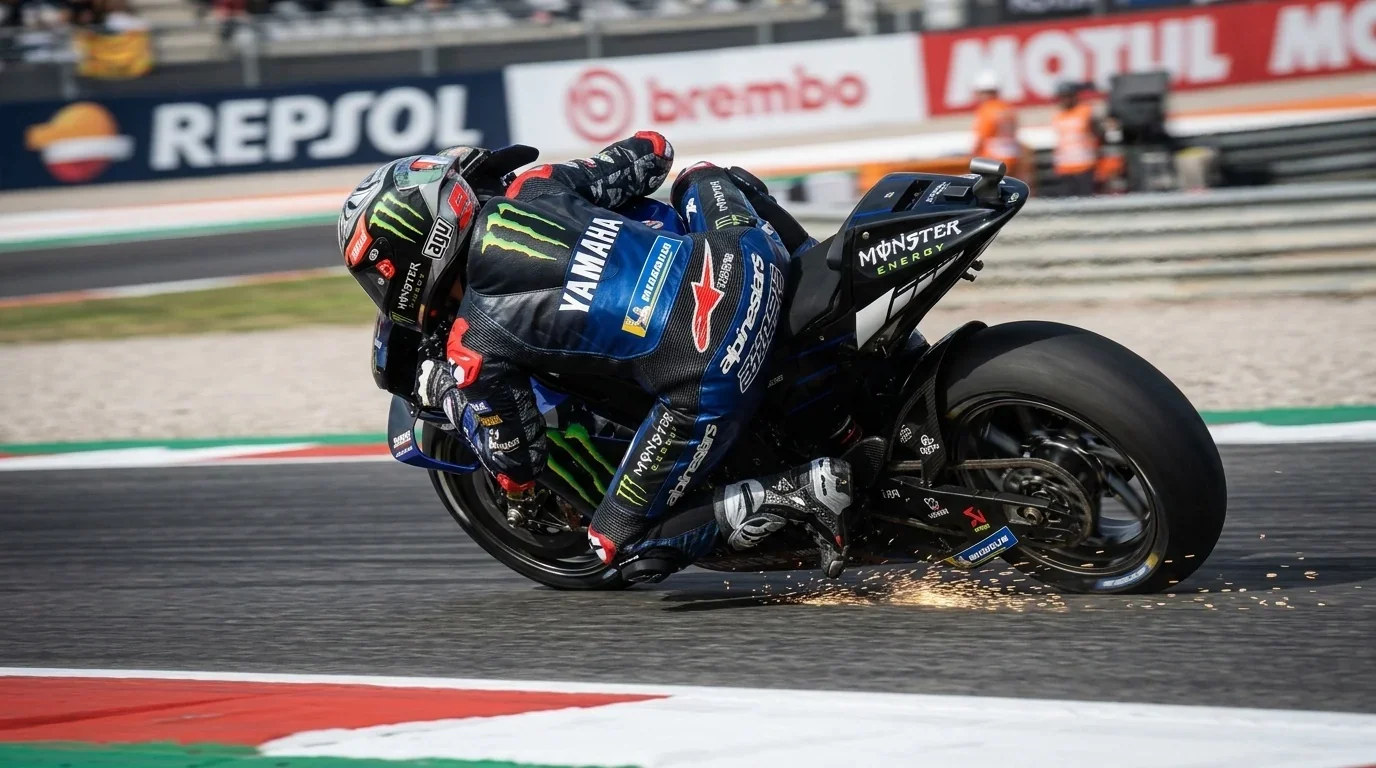
- Extreme Physics: Riders experience up to 1.5g of braking force and routinely lean the motorcycle over at angles exceeding 64 degrees.
- Aerodynamic Revolution: Winglets and ground-effect fairings have transformed modern racing, increasing downforce but altering how bikes handle in dirty air.
- Strategic Tire Management: Winning requires balancing Michelin's strict tire pressure thresholds and managing thermal degradation over a full race distance.
The Anatomy of a Prototype: What Makes a MotoGP Bike?
To understand MotoGP, one must first understand that these machines share almost nothing with the sportbikes found on public roads. Every component—from the carbon-fiber brake discs to the custom-machined magnesium wheels—is designed solely for track performance. The engines are restricted to a 1000cc capacity with a maximum cylinder bore of 81mm, yet they produce upwards of 300 horsepower.
In recent years, the engineering focus has shifted from raw horsepower to aerodynamic downforce and mechanical grip. Manufacturers like Ducati, Aprilia, and KTM have pioneered complex winglet configurations. These aerodynamic packages create massive downforce at high speeds, suppressing front-wheel lift (wheelies) under acceleration and stabilizing the chassis during high-speed braking.
Alongside aerodynamics, ride-height devices (often called holeshot devices) have revolutionized the sport. By mechanically compressing the rear suspension at the exit of a corner, riders lower the bike's center of gravity. This geometry change drastically reduces the tendency to wheelie, allowing riders to apply full throttle much earlier than previously possible.
The Three Tiers of Grand Prix Motorcycle Racing
The FIM World Championship Grand Prix is divided into three distinct classes. Each serves as a stepping stone, preparing riders for the brutal power and complexity of the premier class. Understanding these distinctions highlights the immense step up in performance that the premier class represents.
| Specification | Moto3 | Moto2 | MotoGP |
|---|---|---|---|
| Engine Type | 250cc Single-Cylinder | 765cc Triple (Triumph Spec) | 1000cc V4 or Inline-4 |
| Approx. Horsepower | 60 hp | 140 hp | 300+ hp |
| Minimum Weight | 152 kg (with rider) | 217 kg (with rider) | 157 kg (bike only) |
| Electronics | Highly Restricted | Controlled ECU | Unified Magneti Marelli ECU |
The Human Cost: Physical Demands on a MotoGP Rider
While the engineering is mind-boggling, the human element remains the deciding factor. A MotoGP rider must possess the cardiovascular endurance of a marathon runner combined with the explosive strength of an Olympic gymnast. During a 45-minute race, a rider's heart rate frequently hovers between 170 and 190 beats per minute.
The physical strain of stopping a 157-kilogram motorcycle from 350 km/h down to 90 km/h is immense. Riders must brace their entire upper body against the fuel tank to resist forces of up to 1.5g. This constant deceleration puts immense pressure on the forearms, frequently leading to chronic exertional compartment syndrome, commonly known as "arm pump." This condition restricts blood flow and can cause riders to lose feeling in their hands mid-race, often requiring surgical intervention to relieve pressure in the forearm fascia.
PRO TIP: Watch the Corner Exit
When watching a race broadcast, keep your eyes on the rear of the bikes as they exit slow corners. You will see the rear chassis suddenly drop by several inches. This is the rider manually activating the ride-height device via a handlebar lever to squat the bike, lower the center of gravity, and maximize forward drive.
Scenario 1: Navigating San Donato (Mugello)
To visualize the physical toll, consider a rider approaching Turn 1 (San Donato) at the Mugello Circuit in Italy. Cresting a slight hill at 360 km/h, the front wheel momentarily lifts off the ground. The rider must immediately sit up, using their chest as an aerodynamic brake, while pulling the front brake lever with just two fingers. As the carbon brakes reach temperatures exceeding 800°C, the rider downshifts through the seamless-shift gearbox without a clutch, shifting their body weight completely off the side of the bike to prepare for a 64-degree lean angle, all within a window of less than five seconds.
Common Misconceptions and Strategic Mistakes
A common mistake among casual observers is assuming that the fastest bike always wins. In reality, modern Grand Prix racing is a delicate exercise in tire preservation and thermal management. MotoGP uses control tires supplied by Michelin. These tires are highly sensitive to both operating temperature and pressure.
Scenario 2: The Dirty Air Trap
If a rider qualifies in fifth place but has the raw pace to win, they cannot simply charge through the field. Riding closely behind another 1000cc machine subjects the front tire to "dirty air"—turbulent, hot exhaust gases. This lack of clean air reduces cooling, causing the front tire pressure to spike. Once the pressure exceeds the optimum window (typically around 1.88 bar), the tire loses grip, causing the front end to slide unpredictably. A rider must strategically drop back by half a second to get clean air, cooling the tire before planning their next overtaking maneuver.
Another misconception is that rider aids like traction control make the bikes easy to ride. In truth, MotoGP traction control is not a safety net designed to prevent crashes; it is a performance tool designed to keep the rear tire spinning at an optimal slip ratio (e.g., 10-15% faster than the front tire) to steer the bike using the rear wheel. The rider must still manage the throttle with millimeter precision to prevent violent high-side crashes.
The Road Ahead: The 2027 Regulatory Pivot
The sport is currently in a fascinating transitional phase. As we progress through the 2026 season, teams are operating under the final year of the current technical cycle. In 2027, MotoGP will undergo its most radical regulatory overhaul in a decade. Engine displacement will shrink from 1000cc to 850cc, ride-height devices will be banned entirely, and aerodynamic surfaces will be heavily restricted.
This upcoming change forces manufacturers to split their resources. They must continue developing their current machines to win today while simultaneously designing entirely new engines and chassis for the future. It is a high-stakes balancing act that could completely reshuffle the competitive order of the paddock.
Frequently Asked Questions
What is the difference between MotoGP and World Superbike (WorldSBK)?
MotoGP utilizes prototype motorcycles built from scratch solely for racing. WorldSBK uses highly modified production motorcycles that you can buy from a dealership, such as the Yamaha R1 or Kawasaki ZX-10RR.
Why do MotoGP riders stick their leg out when braking?
Known as the "leg dangle," this technique acts as an aerodynamic brake, shifts the rider's center of gravity slightly lower and further back, and physically blocks trailing riders from attempting an inside overtake.
How long does a MotoGP engine last?
Due to strict reliability regulations, riders are limited to a set number of engines per season (typically 7 or 8). This means an engine must reliably endure roughly 2,000 to 3,000 kilometers of extreme track abuse before being retired.
Are MotoGP bikes all-wheel drive?
No. MotoGP regulations strictly mandate that power can only be delivered to the rear wheel. All-wheel-drive systems are banned.
The Ultimate Pursuit of the Limit
Ultimately, MotoGP remains the ultimate expression of speed on two wheels because it refuses to compromise. It demands absolute perfection from both the engineers drawing up aerodynamic profiles in wind tunnels and the riders risking everything on the asphalt. For fans, appreciating the sport goes beyond watching who crosses the finish line first; it lies in recognizing the staggering engineering, strategic tire preservation, and sheer physical courage required to keep a 300-horsepower machine balanced on a patch of rubber no larger than a credit card.